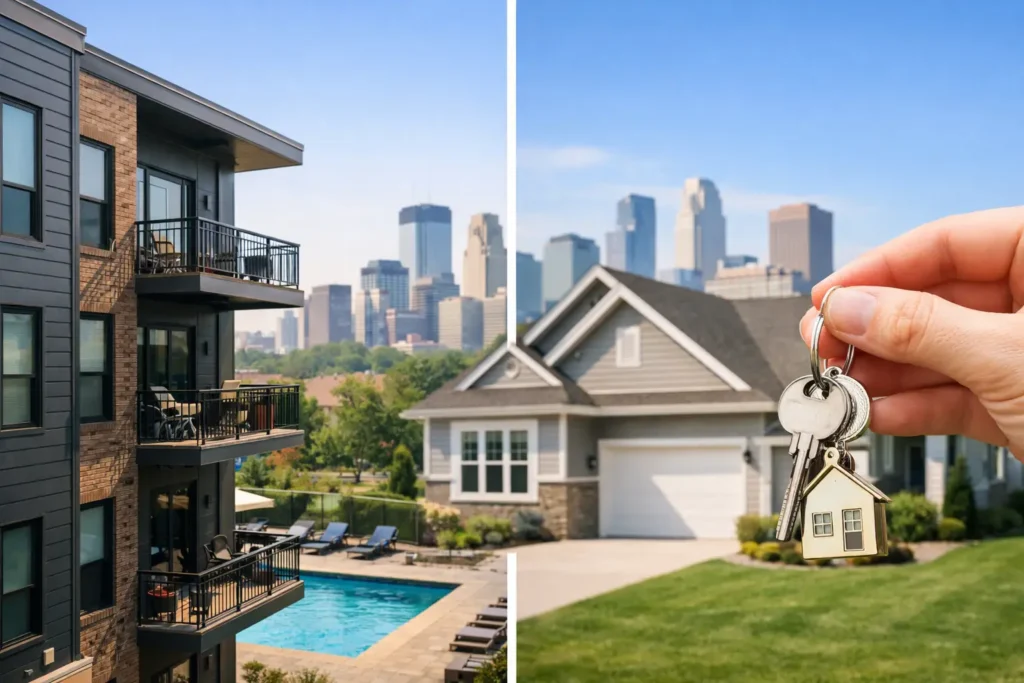
A one-bedroom apartment in the Twin Cities can feel manageable right up until the lease renews. A starter home can look affordable right up until you price insurance, taxes, repairs, and closing costs. That is why renting vs owning in Minnesota is not a simple math problem. It is a timing, cash flow, and risk decision shaped by your goals, your market, and how long you plan to stay put.
For some households, renting is the smarter move for now. For others, owning creates stability and a better long-term financial position. The right answer depends less on what people say you should do and more on whether the numbers and responsibilities fit your life.
Renting vs owning in Minnesota starts with monthly reality
Most people compare rent to a mortgage payment and stop there. That comparison is too narrow. A homeowner’s true monthly cost usually includes principal, interest, property taxes, homeowners insurance, utilities, maintenance, and sometimes association dues. If the property needs work, the budget gets tighter fast.
Minnesota adds its own local pressure points. Property taxes can vary significantly by county and city. Older housing stock, especially in parts of Minneapolis, Saint Paul, and first-ring suburbs, may come with higher maintenance needs. Winter also changes the equation. Heating costs, snow removal, ice management, and weather-related repairs are real ownership expenses, not small footnotes.
Renting, by contrast, often creates a cleaner monthly budget. You know the payment, you can plan around it, and major repairs are generally the landlord’s problem. That predictability matters for people rebuilding credit, saving for a down payment, managing variable income, or simply trying to avoid financial strain.
Still, predictable does not always mean cheaper over time. Rent can rise. A fixed-rate mortgage does not. Over several years, that difference can become meaningful.
When renting makes more sense
Renting is often the better choice when flexibility has real value. If you may relocate for work, are going through a life transition, or are not sure which Minnesota community fits your needs, renting gives you room to adjust without the cost of buying and selling.
It can also be the wiser path if your finances are not fully ready. Buying with a low emergency reserve is risky. Owning a home without cash for repairs, insurance changes, or income disruption can turn a good purchase into a stressful one. If you are still working on credit repair, reducing debt, or building savings, renting can buy you time to strengthen your position.
There is also a local market issue to consider. In some price ranges and neighborhoods, the monthly cost of ownership is substantially higher than rent for a comparable property. If that gap is wide and you are not planning to stay long enough to offset transaction costs, renting may preserve more cash and lower your risk.
That is especially true for first-time buyers who feel pressure to “stop throwing money away on rent.” That phrase oversimplifies the decision. Rent is not wasted if it protects your liquidity, keeps your options open, and helps you prepare for a stronger purchase later.
When owning can create long-term advantage
Owning starts to make more sense when you are financially prepared, expect to stay in place for several years, and want more control over your housing costs and living environment.
One major benefit is payment stability. While taxes and insurance can change, a fixed-rate mortgage gives you a level of predictability that renting usually does not. That matters in markets where rents continue climbing.
Another benefit is equity. Part of each mortgage payment may build ownership over time, and if the property appreciates, you may gain additional value. That does not mean every home is automatically a great investment. It means ownership can support wealth building when the purchase price is sound, the financing is reasonable, and the property fits your timeline.
Owning also gives you control. You can renovate, improve the property, and make decisions without waiting for a landlord. For households planning to stay in one place, that control can be worth a lot.
In Minnesota, ownership can also open future options. A home may later become a rental, a move-up strategy, or part of a broader investment plan. That does not happen by accident. It depends on buying well, understanding local rental rules, and thinking beyond the first transaction.
The hidden factors people miss in renting vs owning in Minnesota
The biggest mistakes usually happen when buyers focus on the purchase and ignore the system around it.
Local compliance matters. If you eventually want to rent out the property, city rules can affect your plan. Some municipalities have rental licensing requirements, inspection standards, occupancy rules, and code enforcement practices that can change cash flow and operational costs. A property that looks like a flexible future asset may come with more oversight than expected.
Condition matters too. A lower purchase price can be attractive, but deferred maintenance can erase the savings. Roof issues, aging mechanicals, drainage problems, permit history, and unapproved work are not minor details. They affect value, financing, insurability, and resale.
Then there is transaction cost. Buying and selling real estate in a short time frame can be expensive. Closing costs, lender fees, title work, repairs, and agent commissions all affect your actual outcome. If you might move within two or three years, ownership may not deliver the benefit you expect.
Investors and higher-income households should think one step further. The right question is not only whether to rent or own a primary residence. It may be whether owning this specific property supports a broader balance sheet strategy, tax-aware planning approach, or future acquisition path. Real estate can build wealth, but only when it fits the larger picture.
A practical way to decide
Start with time horizon. If you are not reasonably confident you will stay for at least five years, renting often deserves stronger consideration. That is not a hard rule, but it is a useful screen.
Next, review your cash position honestly. Can you cover the down payment, closing costs, moving expenses, and still keep reserves? If a furnace fails in January, will that create a crisis? If the answer is yes, you may not be ready yet, even if a lender says you qualify.
Then compare true monthly costs, not just mortgage versus rent. Include taxes, insurance, maintenance, utilities, dues, and likely repair exposure. If you are comparing a house to an apartment, make sure the lifestyle difference is part of the analysis too.
After that, consider your goals. Are you looking for flexibility, lower responsibility, and a cleaner budget? Renting may align better. Are you looking for stability, long-term control, and a base for future wealth building? Owning may be the better fit.
Finally, look at the property itself and the local jurisdiction. Not every affordable property is a good buy. Not every house with upside is easy to operate. This is where local guidance matters. Team Estates often helps clients sort through these questions before they make a move they later regret.
Minnesota buyers should think beyond the first year
The first year of ownership is usually the most expensive because so many costs hit at once. That can make renting look better in the short term. But if the home is affordable, well-selected, and held long enough, the picture can improve.
On the other hand, renters should not assume waiting is always safer. If home prices rise faster than savings, or if repeated rent increases make it harder to build reserves, delaying too long can create its own cost.
That is why the best decision is rarely emotional. It comes from a clear view of income stability, local market conditions, property quality, financing terms, and future plans. Some people should rent longer and do it with purpose. Others should stop waiting and buy with a strategy.
The goal is not to force homeownership or defend renting. The goal is to make a decision that protects your cash flow now and supports your position later. In Minnesota, that usually means slowing down, asking better questions, and choosing the path that gives you the most control rather than the most pressure.