
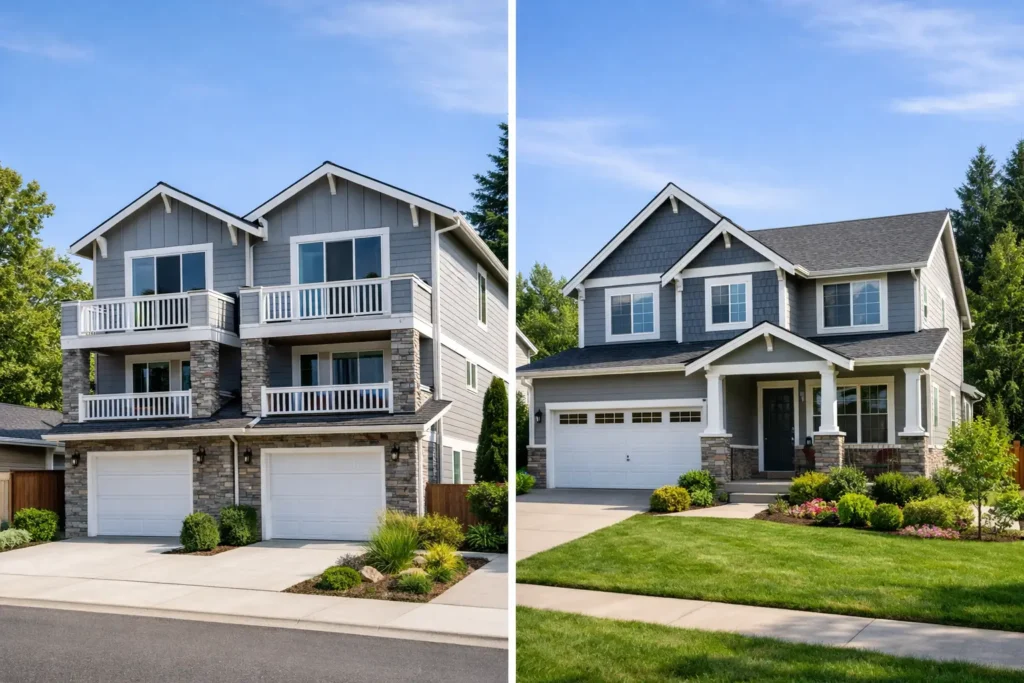
A buyer with the same budget can look at a duplex and a single-family home and end up with two very different futures. One path may offer rental income and faster equity growth. The other may offer simpler ownership, more privacy, and fewer moving parts. That is why the duplex vs single family question is not just about property type. It is about lifestyle, risk tolerance, financing, and what you want real estate to do for you.
For some Minnesota buyers, a duplex is a practical first investment because it can reduce out-of-pocket housing costs while building long-term wealth. For others, a single-family home is the better fit because it is easier to finance, easier to manage emotionally, and often easier to sell later. The right answer depends on what season you are in and how hands-on you want to be.
Duplex vs single family: the core difference
At the simplest level, a single-family home is one residence on its own lot, built for one household. A duplex is one property with two separate living units, often side by side or stacked, with separate entrances and shared structural components.
That physical difference changes almost everything else. A single-family property usually gives you more control over the space, more privacy, and fewer tenant-related issues if you live in it yourself. A duplex creates income potential because one or both units can be rented, but it also introduces landlord responsibility, possible licensing rules, maintenance coordination, and neighbor dynamics under one roof.
This is where many buyers get tripped up. They compare the purchase price but not the ownership experience. A duplex may look more attractive on paper because of rent potential, but if you do not want to handle tenant communication, repairs, lease turnover, or local compliance issues, the extra income may come with more stress than expected.
When a duplex makes more sense
A duplex tends to appeal to buyers who want a property to do more than provide shelter. If your goal is cash flow, house hacking, or building a small rental portfolio, a duplex can be a strong entry point.
For owner-occupants, living in one unit and renting the other can help offset the mortgage payment. That can be especially useful for first-time buyers trying to stretch affordability without jumping straight into a larger investment property. In higher-cost markets or during periods of elevated rates, that rental income can make ownership possible when a single-family home would feel tight.
A duplex can also create a clearer path to scaling. Once you learn how to manage one rental unit, you are closer to understanding leasing, screening, repair coordination, reserves, and long-term asset planning. For buyers who want to grow into investing, a duplex can be a training ground with real upside.
There are also family-based use cases. Some households buy duplexes for multigenerational living, keeping relatives nearby while maintaining separate spaces. Others use one side for an aging parent, adult child, or transitional housing arrangement. In those cases, the value is not only financial. It is flexibility.
Still, the upside only works if the numbers are honest. Vacancy, repairs, insurance, property taxes, utility setup, and turnover costs all matter. A duplex is not automatically a better investment just because it has two units.
When a single-family home is the better move
Single-family homes usually win on simplicity. There is one household, one kitchen, one roofline to think about, and fewer shared-wall issues. For buyers who want stability and personal space, that matters.
A single-family home may also fit better if your primary goal is long-term personal use rather than immediate income. Many buyers value a private yard, more separation from neighbors, easier day-to-day living, and a property that feels less like a business. If you have children, work from home, or simply do not want your housing tied to tenant performance, a single-family property often gives more peace of mind.
Resale can be another advantage. In many markets, the buyer pool for single-family homes is broader than it is for duplexes. That broader demand can help with liquidity later, especially if market conditions tighten. A future buyer may be another owner-occupant, not just an investor, which can support resale flexibility.
There is also a practical reality: some people should not start their ownership journey as landlords. If you are already navigating credit repair, budgeting challenges, or a first purchase with limited reserves, a single-family home may be the cleaner and safer step.
Financing is often where the decision shifts
Many buyers start with preference but end with whatever financing supports best. That is common, and it is not a bad thing.
Single-family homes are often simpler to underwrite and easier for buyers to understand from a lending standpoint. Duplexes can still qualify for owner-occupied financing if you live in one unit, which is a major advantage, but the loan process may involve projected rental income, reserve questions, and tighter scrutiny depending on the borrower profile and loan product.
For investors buying a duplex as a non-owner-occupied property, the terms can look different from a primary residence purchase. Down payment expectations may be higher, rates may differ, and the lender may care more about cash flow strength and overall borrower reserves.
This is one reason the duplex vs single family decision should be made with financing strategy in mind, not after the fact. The better property on paper can become the wrong property if the debt structure strains your monthly budget.
Duplex vs single family for maintenance and management
Every property needs maintenance. The difference is how predictable and personal that maintenance feels.
With a single-family home, you are usually making decisions for your own use and timeline. If the furnace goes out, it affects your household. If the roof needs repair, you solve it based on your own priorities and budget.
With a duplex, repairs can become operational. A plumbing issue in one unit may affect another. Turnover work may need to happen quickly to avoid vacancy loss. Shared systems can create shared problems. And if tenants are involved, your role is no longer just owner. It is operator.
That does not mean duplexes are bad. It means buyers should be honest about whether they want active involvement. Some owners are well suited for that and build meaningful wealth because of it. Others want real estate benefits without day-to-day management, and for them, a single-family home may be the cleaner fit.
In Minnesota, local rules can also matter more than buyers expect. Rental licensing, inspections, occupancy standards, and municipal requirements can affect duplex ownership in ways that do not apply the same way to a typical owner-occupied single-family home. Those details should be reviewed early, especially if the plan includes renting immediately.
Appreciation, cash flow, and long-term strategy
A common debate is whether duplexes are better for cash flow while single-family homes are better for appreciation. Sometimes that is true, but not always.
Duplexes often appeal to investors because income helps justify the purchase. Their value may be tied more closely to rents, expenses, condition, and investor demand. Single-family homes often benefit from broader emotional demand because buyers picture themselves living there, not just analyzing returns.
But market behavior changes by neighborhood, timing, and condition. A well-located duplex can appreciate strongly. A poorly chosen single-family home can underperform. The better question is not which asset class is universally better. It is which one matches your return goals.
If you want monthly income and can handle operations, a duplex may fit. If you want a lower-friction path to ownership with more personal flexibility, a single-family home may be the better choice. If you want both lifestyle stability and future rental potential, some buyers start with a single-family home and convert strategy later.
How to decide with clarity
The best property is the one that still makes sense after you account for financing, reserves, repairs, local rules, and your real capacity to manage it.
Ask yourself a few practical questions. Do you want income now, or simplicity now? Are you comfortable sharing walls or managing tenants? Would a vacancy create financial stress? Are you buying for five years, or building a longer investment plan? Do local zoning, rental rules, or property condition create extra risk you have not priced in?
If you are buying in areas across the Twin Cities or other Minnesota markets, block-by-block differences can matter as much as the property type itself. One duplex may be a strong opportunity with compliant setup and stable rent demand. Another may look affordable but hide deferred maintenance, permit issues, or weak numbers. The same is true for single-family homes.
That is why this decision works best when it is grounded in your actual goals, not a social media opinion about what smart investors are supposed to buy. Team Estates often helps clients sort through that exact tension by looking beyond the listing and into the real strategy behind the purchase.
A duplex can be a wealth-building tool. A single-family home can be a strong strategic asset. The better choice is the one that lets you move forward with confidence, not just optimism.